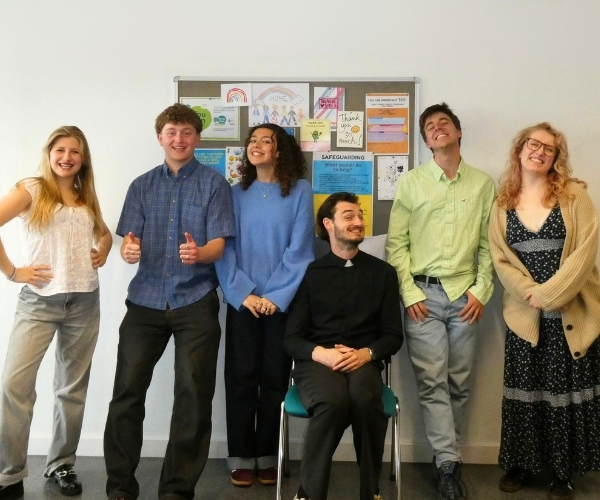
Theatre Village were lucky enough to do an interview with Mille Thomas, the producer of Take Care.
Take Care is inspired by your own time working in a care home for adults with learning disabilities. What was the moment, memory, or feeling that made you think, “This story needs to be on stage”?
Whilst my time working at a care home was incredibly formative and special for me, I don’t think it was until I moved away for university that I realised how much I’d come to rely on the people I worked with, and it was this that gave me a desire to share the experience with others.
The intensity of shift work in an often short-staffed workplace meant I was regularly working up to 90-hour weeks with people who, just a few months before, had been complete strangers to me. We cooked, cleaned, drove and ate together in the same way a family might (albeit a slightly dysfunctional one at times).
In an economy where you can be paid the same to work in hospitality or retail, care work tends to attract people who have an inherent desire to look after others. During my time at the care home, I became increasingly aware of how me and my colleagues looked after each other as well as the residents. When Edie mentioned wanting to write a play set in a care home, I leapt at the opportunity to capture this.
The play is set on New Year’s Day, when most people are celebrating or recovering from the night before. Why did that particular day feel important for the story?
We wanted to highlight how some people require care around the clock and that this doesn’t pause, even for national holidays. It felt particularly important to convey this reality of care work, which can often go unseen or simply not be considered.
Whilst it can be sad spending holidays like Christmas or New Year away from family, I always thought it was a privilege to have the opportunity to bring some holiday joy and make these days special for the people I cared for. It was also on these days that I often felt particularly close to my colleagues, as we worked and celebrated in small ways together.
We also felt that setting the play on New Year’s Day lent itself to exploring who the characters are both inside and outside of their work, and what emotions this day of new beginnings might bring up for them. Our characters all bring vastly different life experiences and personalities to the stage, and the heightened emotions of New Year’s Day provide the context for some heartfelt moments, clashes and comedy which make up the gently undulating sitcom feel of Take Care.
Care work is often spoken about in terms of crisis, funding and pressure, but your description also mentions humour and connection. How important was it to show the warmth and absurdity of the job as well as the difficulty?
It was incredibly important for us to focus on the warmth that can be found in care work, primarily through humour and connection with colleagues and residents.
A special thing about working on national holidays is that the external noise seems to pause, allowing more focus on the job of caring itself rather than working through paperwork or emails, for example.
Unfortunately, the pressures of being part of a vastly under-resourced sector do have a massively negative impact on health and social care. However, in Take Care, Edie deploys the feeling of a “bubble” created by New Year’s Day to focus on the emotions and relationships of the individual people working in the home, rather than external issues which can detract from the warmth and connection at the heart of care work.
The play seems to focus not just on residents, but on the relationships between colleagues. From your experience, how vital are those workplace bonds in care environments?
The play primarily focuses on the relationships between colleagues, as this is the lived experience I felt I could speak to and that we could portray sensitively and truthfully.
Workplace bonds are vital in creating a happy environment for both residents and staff in care homes. Positive colleague relationships promote healthy communication, teamwork and problem-solving, all of which are essential, especially in the face of adversity.
Was there anything from your own experience that you knew absolutely had to be represented honestly, even if it was awkward, messy or uncomfortable?
One of my favourite moments in Take Care is a conversation about drunken escapades between colleagues of vastly different ages which results in a stunned silence.
Awkward (and often hilarious) conversations with older colleagues were somewhat of a staple of my time at the care home, and I’m so glad Edie captured a similar atmosphere.
Take Care has already had a sold-out run at The Alma Tavern Theatre. What did you learn from audiences during that first run?
We had such a lovely reception to our run at The Alma Tavern Theatre, and the main thing we learnt was that people were really keen to engage with the play and the characters’ stories.
It was also incredibly valuable to receive feedback on how we could make the play even more nuanced and enjoyable. We’ve been working on that for our shiny new Fringe edition of the show, which we can’t wait to share.
As producer, how do you balance protecting the truth of lived experience with creating something theatrical and engaging for Fringe audiences?
Whilst Take Care is based on my knowledge of a care home environment, we focused on capturing the feeling of my experience rather than recreating any particular moments or people.
One of Edie and my first discussions was around how we would protect the truth of lived experience and make the play as ethical as possible in its creation. This led to a process where we held an initial brainstorm of ideas, which Edie then used to create a first draft. I then edited it purely from a dramaturgical perspective, considering what action would realistically take place in the staff room of a care home and how it might unfold.
Edie has done an incredible job writing and working with our actors to create rich and interesting characters whose reactions to moments of shock, tension and comedy are intricate, finely tuned and very theatrically engaging.
Late Shift Theatre Company was founded by a young Bristol-based team. Do you feel student-founded and emerging companies are bringing different stories into theatre right now?
Being students at the University of Bristol for the last three years has been an incredibly vibrant experience, and we’ve had the privilege of seeing so many student-founded companies flourish, which gave us the confidence to start our own.
We love watching student-founded and emerging companies’ work, with so many creative and fresh ideas constantly inspiring us. We are especially excited to see other Bristol-based, student-created shows at the Edinburgh Fringe, including God Complex and Body Parts.
Interested in seeing the show? Take Care | Edinburgh Festival Fringe It’s on 24th to 29th August
About the Author
