Morning, darlings!
If you’re munching on your toast or stirring your cuppa, let me sprinkle a bit of theatrical gossip into your breakfast bowl. I’ve just had the absolute treat of nattering with the fabulous Sadie Pearson – yes, the brain behind the razor-sharp show Rodney Black: Who Cares? It’s Working.
Sadie’s not one to shy away from bold questions or uncomfortable truths, and this play is proof of that. You’ll find it making its London mark at Riverside Studios on 29th July, before high-tailing it up to Edinburgh for the Fringe, where it’ll be playing 18th–25th August at the iconic Gilded Balloon.
Mark it in your diary, scribble it on your arm – whatever you do, don’t miss it. Grace has spoken.
- What inspired you to create a character like Rodney Black – someone
who thrives on provocation yet hides behind the idea that it’s “just a
joke”?
Comedy is a brilliant grey area for morality, and one which differs from person to person. We all have our own lines that shouldn’t be crossed, and most of us have things that tickle our funny bone which probably shouldn’t. What’s interesting now is the degree to which social media is shaping the comedy landscape and shifting the position of these lines. As a platform which thrives on the conflict – the more rage bait, the more clicks, the more monetary successes! Rightly or wrongly, exposure is an easy way to become a celebrity.
I have a dark sense of humour and, I like to think, a strong moral compass. I don’t think the two are incompatible with one another. But, in this new technological age, should we all be more careful? And what are the consequences if we decide that we aren’t accountable for what we say?
This play dives into the heart of that, and it’s required a lot of nuanced interrogation.
- The play explores the fallout of cancel culture. How do you
personally define accountability versus censorship in the world of
comedy?
That’s a great question – and something the play itself is looking to explore. It follows a comedian who has to determine his own ethical limits after a fan takes a joke of his as a call to arms. The big question at the heart of the play is how responsible is he? And – if he is – should his joke have been said in the first place?
I’m not sure I have a concrete answer for you – but I do have some thoughts. See, what I wrestle with, is the idea of an absolute right to freedom of speech versus having an ethical sensibility of what ‘should’ or ‘shouldn’t’ be platformed. Of course – subjective – just as comedy is… And in an ideal world, we should be able to platform all voices, as a symbol of genuine democracy. Yet there are real world implications for everything we say – particularly as artists with platforms to influence – and it would be irresponsible to not take accountability for this.
Post show, in the bar, there have been a lot of debates – often heated – on where the line should be drawn for what is acceptable or not in comedy. On whether Rodney is responsible or not. I encourage you to head down to the show and be a part of it!
- Rodney’s public persona seems to diverge dramatically from his
private beliefs. Was this contrast inspired by any real-world figures?
I wrote the play following the rancid headlines about Russell Brand which hit the press last year – and was morbidly fascinated by how he had been making jokes on national stages about the very assaults he was later accused of enacting. It felt like a transparent curtain had been lifted– leaving the nation shocked to see his ‘true character’, yet it was something that had always been right in front of us. At the same time, Ricky Gervais was making headlines for his comments against trans women, views which I personally believe are fascistic and repellent, and – later – Matt Rife made headlines for his comedy about domestic abuse victims. These are all men who, I believe, hold the misogynistic views they platform in their private lives – not just on stage. And yet, they could all defend themselves against that accusation, through the classic “it’s just a joke” and, when challenged on this, became martyr-like symbols of freedom of speech.
When writing the play, it felt more interesting to write a character who supposedly doesn’t believe what he is saying. You can’t empathise with someone like Brand on stage anymore – at least I can’t – but with Rodney there are more layers.
- Comedy has often been a vehicle for uncomfortable truths. Do you
think there are lines that shouldn’t be crossed—or should all topics be
fair game if handled thoughtfully?
Definitely the latter. Our issue today is that it does not feel like some comedians are handling topics sensitively, particularly young men propelled into the limelight through algorithms that favour controversy over all else. It can feel like the floodgates have been opened for a new brand of bitingly misogynistic humour, rooted in archaic ideals which I thought we abandoned decades ago. The cash/fame incentivisation of the ‘shock-factor’ is dangerous, it removes critical thinking and – frankly – the artistry of comedy. It’s a lot easier to say something offensive than something funny – as you learn quickly with a scroll on social media.
That’s why we’re partnering with the amazing charity Everyone’s Invited for the fringe. They tackle misogyny and rape culture at its root, in schools across the country, educating young men on the patriarchal world they are entering into. It’s brave work, and vital for these times, pushing back against the onslaught of misinformation and radicalisation which takes place online – often, initially, as ‘comedy’. It’s a real privilege to be bringing not only our show, but their messaging, to more people.
- How have comedians and the stand-up scene responded to your script,
if they’ve seen or read it? Any surprising reactions?
When I travelled to the Alpine Fellowship symposium with this play, I met the brilliant stand-up Rich Hardisty, whose show POP is heading to the fringe this year. A hilarious, heartfelt show about his one-man-mission to find his biological father – totally different to the comedy of Rodney! It was really interesting chatting to him about my play and listening to his own opinions of ethical responsibility as an artist, and his experiences of the industry – and a validating experience, that I was writing about something relevant and real.
I also recently reached out to a (to remain-unnamed) famous stand-up to see if he fancied coming along to one of our London previews. Funnily enough, we’d met at last year’s fringe with my own show already written, when I uncovered he’d had his own ‘cancellation’ for a joke gone awry. Maybe the invite felt a little close to home, however, as I was told to bugger off quite promptly. Still, I’d love to hear his opinions. Maybe this year I can tempt him…
Playing at Gilded Balloon – Scotland’s biggest comedy producer – I should hope we will get some stand-ups sat down in our seats.
- What hopes do you have for this production at Edinburgh Fringe?
We’d love to get more people involved in our free speech debate. Our audiences have been the best bit of every night for us, and conversations in the bar afterwards are electric. It would be amazing if we could get some more stand-ups into the heart of the conversation, especially women, whose voices should always be the loudest on issues of misogyny in the industry.
- Can you tell us more about yourself, how you got into writing and
what are you most passionate about?
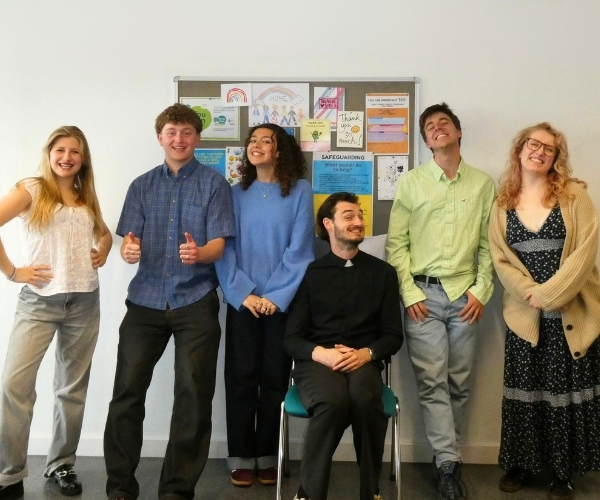
I’m a proud founding member of Full Frontal Theatre – myself as the writer, Hen Ryan our director and Grace Shropshire as our producer – and we’re a real dream team. We founded last year, studying theatre at The University of Bristol, and have now got two plays under our belts which have titillated audiences across the country. Creatively, we are all on the same page, in that we enjoy work which isn’t afraid to genuinely challenge or go to a dark place. Equally, we love to entertain. My first play To Watch a Man Eat was a great example of this – a dirty dark comedy which we took to London, Bristol, The Shakespeare North Playhouse and Fringe – dubbed Backstage Bristol’s top 3 plays of 2024 and certainly a shock-to-the-system for anybody expecting PG. It followed a Macbethian-style-saga of an investment banker and his partner in the pursuit of idealised capitalistic successes, flipping the house-wife trope on its head.
The political is always at the heart of my writing. I am staunchly a feminist, I care deeply about class issues and when I’ve got an opinion I’m not afraid to say it. I think theatre, as a live art with a (hopefully) absorbed audience, is an exciting medium to hit people where they least expect it.
Buy your tickets here:
Rodney Black: Who Cares? It’s Working | Edinburgh Festival Fringe
About the Author