By Grace Hatchell
There are certain phrases capable of transporting a person straight back to early-2000s Britain.
“Top up your phone.”
“Meet us outside Woolworths.”
“Your mate has put a song on his MySpace page and it is clearly about you.”
And now, somewhere in a small Northern town, a teenage boy is trying to work out what on earth it means to become a man.
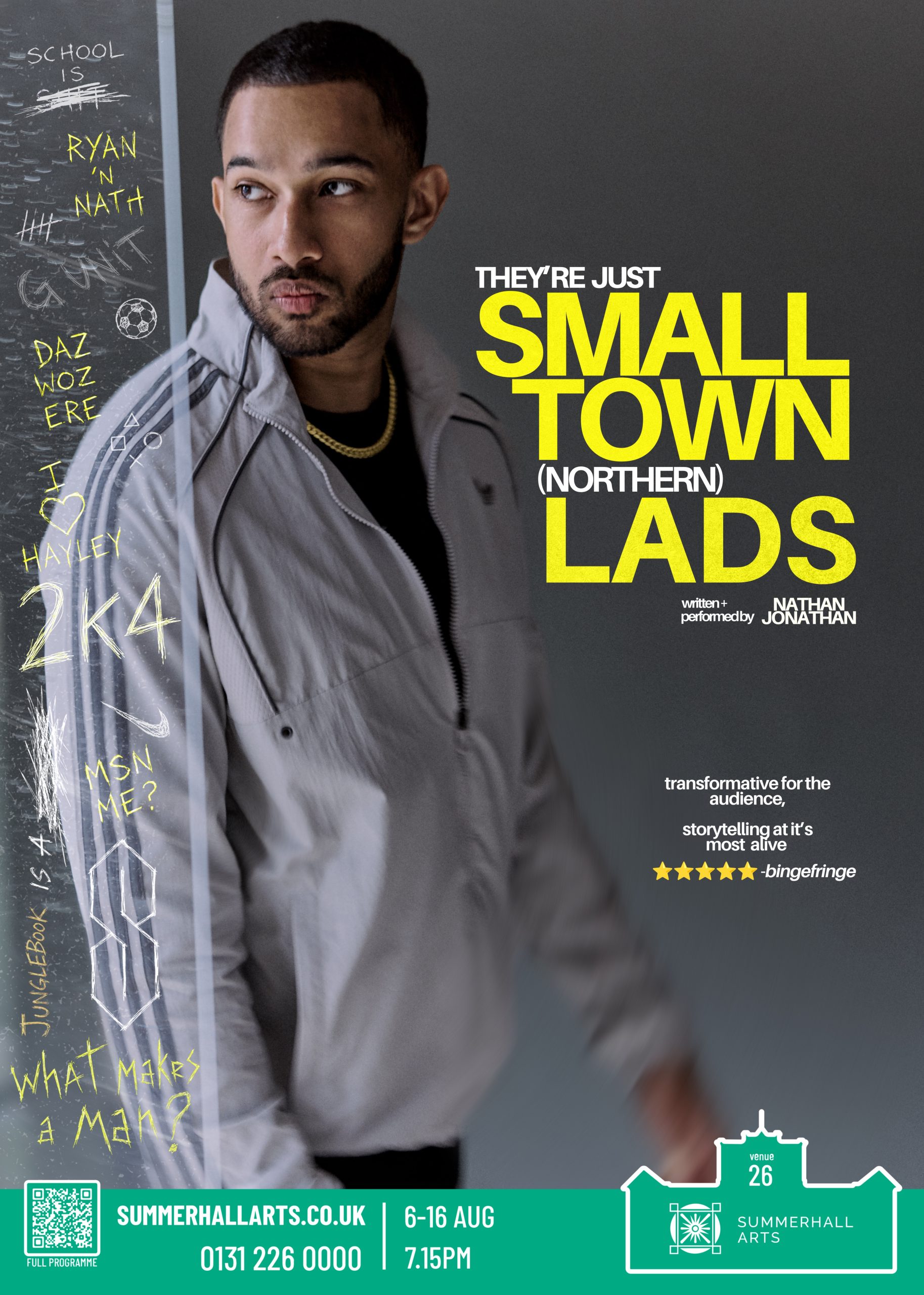
They’re Just Small Town (Northern) Lads comes to Summerhall for the Edinburgh Festival Fringe 2026, bringing with it boyhood, masculinity, mixed-race identity, working-class life and what its creator describes as a healthy dose of unapologetic chavviness.
Performances begin at 7.15pm, which gives everybody plenty of time beforehand to eat something beige from a paper tray and remember when a ringtone could cost £3.50.
Growing up in Y2K Britain
Set in the early 2000s, the play follows a mixed-race teenage boy growing up in a small working-class Northern town.
This is Britain before smartphones took over every waking moment. Before everybody photographed their tea. Before teenagers could conduct an entire emotional crisis through twelve disappearing messages and a strategically selected song lyric.
Instead, this is a world of bus stops, local reputations, hand-me-down ideas and young men learning how to behave by watching the older ones around them.
At the centre of the play is one deceptively simple question:
What makes a man?
It is the kind of question people have been answering badly for generations.
Is it toughness? Loyalty? Responsibility? Silence? The ability to put up a shelf without reading the instructions and then insist the slight angle is intentional?
For a teenage boy trying to understand himself, the answer is unlikely to come neatly packaged.
The things boys inherit
The play explores the things young men inherit from those around them.
Not merely names, football teams or an old coat that smells faintly of somebody else’s garage.
They inherit rules.
How to speak. What not to admit. When to fight. When to pretend they are not hurt. Which emotions are acceptable and which must be pushed down until they emerge twelve years later during an argument about a parking space.
Boys are often taught what masculinity looks like long before they are given any opportunity to question it.
In a small town, those expectations can feel especially powerful. Everybody knows everybody, or at least claims to. Families have histories. People remember what your older brother did in 1997. A mistake can travel down the high street faster than a mobility scooter outside Greggs.
For a mixed-race boy, questions of belonging may carry another layer.
Who decides whether you fit?
How do you build an identity when the town, your family and the men around you may all have different ideas about who you should become?
Nostalgia without pretending everything was wonderful
Early-2000s nostalgia is having a moment.
People remember the music, the clothes and the joy of owning a phone that could survive being dropped down a flight of stairs.
We are slightly quieter about the frosted hair.
But nostalgia becomes more interesting when it is allowed to contain complications.
A Northern working-class childhood can be full of humour, affection and fierce community, while also carrying narrow expectations about race, class and masculinity.
The best nostalgic theatre does not merely point at an old tracksuit and wait for applause. It uses the past to show us where we came from and what we may still be carrying.
They’re Just Small Town (Northern) Lads sounds interested in both the warmth and the weight of that world.
It can laugh at the era without pretending growing up within it was easy.
Sharp, poignant and gloriously chavvy
The show is described as sharp, poignant, nostalgic and hopefully very funny.
The “hopefully” is endearing.
Writers know better than to announce that something is hilarious with complete confidence. That is how you end up watching an audience examine their shoes while somebody on stage sweats through a waistcoat.
Still, the ingredients are promising.
Teenage boys are funny, often without intending to be. They can communicate entire friendships through insults, shoulder barges and the sharing of one suspiciously warm bottle of fizzy pop.
Working-class Northern life also comes with its own rhythm, language and humour. Affection may be disguised as mockery. Concern may arrive as, “You look rough.” A heartfelt declaration of loyalty might simply be, “I’ll come with you, then.”
That humour matters because stories about masculinity can become very earnest very quickly.
A play can ask serious questions without behaving as though everybody has been summoned to a disciplinary meeting.
A complete reimagining
This production is not simply a revival of an earlier piece.
The script has been rebuilt from the ground up, retaining only its period setting and central themes.
That suggests the creative team has gone back to the foundations and asked what the story needs to become now.
The new version has been developed with dramaturg Owen Nicholls and features completely new direction from Amanda Huxtable.
Dramaturgy is one of those theatrical words that can make ordinary people nod thoughtfully while wondering whether it involves moving furniture.
In practice, it can mean helping a writer interrogate the shape, purpose and emotional truth of a script.
If this play has been entirely reconsidered, rather than lightly dusted and sent back onto the stage, that makes its Fringe arrival particularly intriguing.
A reimagining can sharpen what matters.
It can remove what no longer works.
It can also expose the writer to the devastating discovery that the scene they loved most was, in fact, three pages of somebody entering a room.
Grace remembers the early 2000s
I remember Y2K Britain.
We thought the Millennium Bug might destroy civilisation, then woke up to discover the toaster still worked.
Fashion was largely based on the question, “How many pockets can one pair of trousers hold?”
Teenage boys travelled in groups, occupied entire pavements and wore enough hair gel to withstand coastal weather warnings.
Yet beneath all that confidence, boys were still trying to understand the rules.
Do not cry.
Do not look weak.
Do not stand out too much.
Do not admit you care.
But also somehow grow into a kind, emotionally capable adult without anybody teaching you how.
A flawless system.
No notes.
That is why They’re Just Small Town (Northern) Lads feels timely despite its early-2000s setting. We may have changed the phones and trousers, but many of the old expectations are still rattling around.
Why this could be a strong Summerhall show
Summerhall has a reputation for work that is personal, political and willing to take creative risks.
This play appears to fit comfortably into that territory.
It has a distinctive time and place, a clear central question and a perspective that is still not represented nearly enough on stage: a mixed-race working-class Northern boy trying to understand who he is becoming.
The local detail may make the story specific, but its questions are much wider.
Most people understand the experience of inheriting expectations they did not choose.
Most people have wondered whether belonging requires them to shrink, perform or conceal part of themselves.
And most people have met at least one man who could benefit from sitting quietly and considering his emotional inheritance.
Preferably before speaking again.
Grace’s verdict
This sounds like a small-town story with a much bigger reach.
The Y2K setting brings humour and nostalgia, but the central questions around masculinity, race, class and belonging give it real substance.
I also like that the team has been willing to tear up the earlier version and start again.
That takes nerve.
It is much easier to move two scenes around, change a character’s coat and declare the production “boldly reimagined.”
Instead, this has been rebuilt with a new script, new dramaturgical input and new direction.
They’re Just Small Town (Northern) Lads could be funny, tender and uncomfortably recognisable.
It may leave audiences remembering their own teenage years.
Which is either a gift or a threat, depending on the haircut.
They’re Just Small Town (Northern) Lads | Edinburgh Festival Fringe
They’re Just Small Town (Northern) Lads — Edinburgh Fringe 2026
Venue: Summerhall
Time: 7.15pm
Festival: Edinburgh Festival Fringe 2026
Performer: Nathan Jonathan
Dramaturg: Owen Nicholls
Director: Amanda Huxtable
About the Author