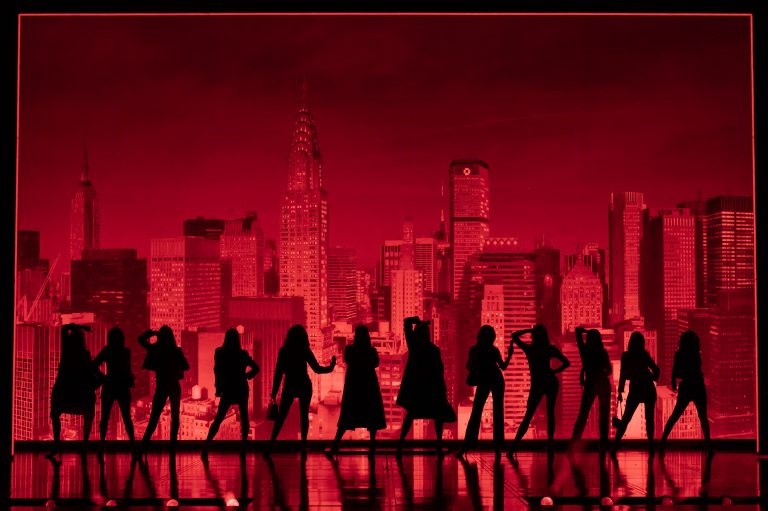
There are some productions at the Edinburgh Fringe where you can immediately see the amount of thought, creativity and artistic precision that has gone into putting them on stage.
Peregrinations is certainly one of them.
This is a powerful wordless work of masked physical theatre and puppetry exploring displacement and the immigrant experience in America. Created from interviews and the lived experiences of an international ensemble, it uses masks, puppetry, original music and physical movement to explore border crossings, exile, separation, belonging and the barriers placed in front of those attempting to build a new life.
And it does all of this without relying on conventional dialogue.
The production is beautifully put together.
Carefully constructed elements intertwine throughout the performance, creating a story in an unusual and deliberately abstract way. Movement, masks, puppetry and music become the language of the production, leaving the audience to interpret much of what they are seeing for themselves.
There isn’t necessarily one prescribed way to perceive these characters.
For me, however, there was something almost alien-like about their appearance.
That immediately made me think about the use of the word “alien” in the United States when referring to immigrants and those entering the country from elsewhere.
Whether that interpretation was specifically intended or something I personally brought to the production almost doesn’t matter. That’s one of the interesting things about this style of theatre: two audience members can watch exactly the same image and potentially take something completely different away from it.
What becomes much clearer is what these characters experience.
Without words, Peregrinations shows us people trying to navigate the hoops and obstacles involved in gaining legal entry. We see separation, including the separation of families. We see people carrying hopes and dreams of something better, only for those dreams to increasingly encounter barriers, bureaucracy and despair.
The production explores what happens when systems stop seeing individuals and instead begin processing people as problems to be managed.
That’s where some of the imagery becomes particularly effective.
These aren’t lengthy political speeches or characters standing in front of us explaining their circumstances. The company instead uses bodies, movement and visual storytelling to communicate experiences that are often reduced elsewhere to statistics and headlines.
Creatively, Peregrinations is extremely accomplished.
It is evident that an enormous amount of thought has gone into how each element works alongside the next. Nothing feels randomly placed on stage simply because it looks interesting. There is intention behind the movement and imagery, and the original music helps establish an atmosphere in which the audience can become immersed.
From a purely theatrical and critical perspective, I can easily understand Peregrinations receiving five-star reviews.
The creativity is there.
The originality is there.
The skill is there.
And yet, personally, there was one thing stopping me from reaching five stars.
I wanted a moment of connection with the real people behind these stories.
That’s an unusual criticism because the abstraction is simultaneously one of the production’s greatest strengths.
The masks allow these characters to represent something much bigger than one individual. They can become displaced people everywhere – people crossing borders, leaving families behind, facing rejection and searching for somewhere they can simply belong.
But for me, that universality also created a little emotional distance.
I was immersed in the production, but I remained conscious that I was watching a highly stylised theatrical world.
At some point, I wanted that world to stop.
Just briefly.
I wanted a pause or change of texture that allowed me to reflect on the fact that the experiences inspiring what I was watching didn’t begin on a stage.
They happened to real people.
One possible way of achieving that could be a very short film or visual sequence incorporating real experiences or testimony from some of the people whose stories helped inspire the production.
Not a lengthy documentary and certainly nothing that overwhelms the physical theatre.
Perhaps just a glimpse.
A name. A face. A voice. A sentence.
Something that suddenly connects the abstract figures we’ve been watching with the human beings whose experiences sit underneath them.
That’s only one possible creative solution, of course, and others may feel that introducing something so literal would undermine the production’s commitment to wordless storytelling.
But for me, that bridge was missing.
Because there is a danger with beautiful theatrical abstraction that suffering itself can become beautiful to watch.
You can admire the masks.
You can admire the movement.
You can admire the puppetry and music.
And you can remain safely sitting on the other side of it.
With subject matter involving displacement, family separation, hostility and the loss of hope, I wanted one moment where that safety disappeared and the human reality behind the artistry hit me directly.
Perhaps that’s also testament to the strength of the production: it made me think considerably about what I was watching and, afterwards, about what I felt was missing.
Peregrinations raises important questions about migration, belonging and the way people are treated when they find themselves on the wrong side of a border.
It does so with imagination, considerable theatrical skill and some striking visual storytelling.
Artistically, there is very little to fault.
Emotionally, I just wanted it to reach through the abstraction and grab me once.
Had it done that, I suspect I would have been looking at a five-star production.
As it stands, Peregrinations is a beautifully crafted and thought-provoking piece of physical theatre that deserves an audience – and, perhaps most importantly, deserves discussion and changes afterwards.
★★★★ 4 Stars- Beautifully crafted, visually striking and deeply thought-provoking.
https://www.edfringe.com/tickets/whats-on/peregrinations
About the Author