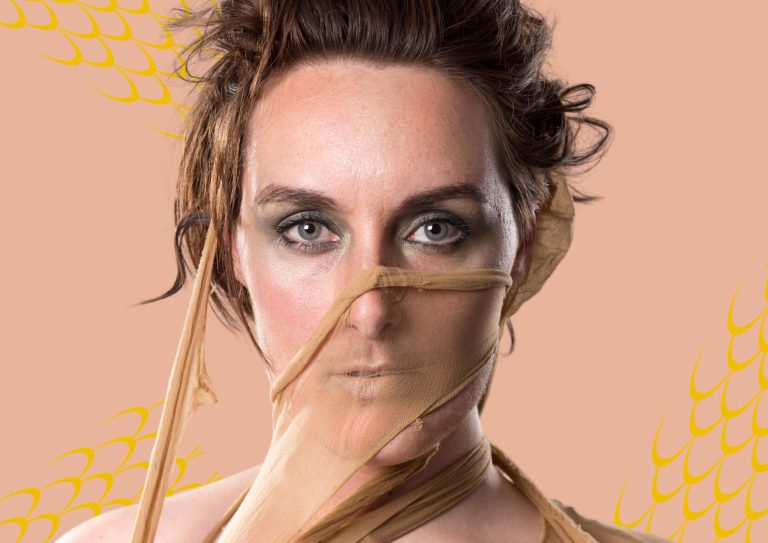
KOHLHAAS adapted from the novella by H. von Kleist ; Rehearsals ; Cast: Arinze Kene ; Adapted by M. Baliani and R. Rostagno ; Translated and Directed by O. Elerian ; Brighton Dome Corn Exchange, Brighton, UK ; 10 May 2026 ; Photo by: Helen Murray
By Grace Hatchell, currently somewhere between a hill and a bad decision, with a satchel full of press releases and one very questionable sense of direction
Kohlhaas opens Brighton Festival 2026 (1–25 May) as its first original theatre production, directed by Omar Elerian and starring Arinzé Kene, with over 100 events from 140+ artists across theatre, music, dance and more.
Now I’ll tell you what… it takes a lot for me to leave me usual routes, but here I am, pedalling down towards Brighton like I’ve got something to prove. And honestly? After what’s landed in me satchel this morning, I think I might actually make it.
Because Brighton Festival is celebrating its 60th edition this year — and it’s not doing it quietly.
Running from 1–25 May, it’s bringing together over 100 events from more than 140 artists across theatre, dance, music, literature, visual art and debate. Proper full city takeover, this. Not just a festival — a whole atmosphere.
But the bit that made me nearly miss a turning (and that’s saying something)… is what’s opening it.
Kohlhaas.
And not just any opening show — this is the first original theatre production ever produced by Brighton Festival itself. Took them 60 years, and now they’ve gone and made it count.
It runs from 1–5 May at Brighton Dome’s Corn Exchange (press night 2 May), and it’s directed by Omar Elerian — who you might know from Rhinoceros or Bengal Tiger at the Baghdad Zoo. And starring? Arinzé Kene, three-time Olivier nominee, stepping back into a one-man show with Elerian for the first time since Misty.
Now that pairing alone is enough to make you sit up a bit.
But the story… oh, the story’s got teeth.
It’s based on Heinrich von Kleist’s 1810 novella Michael Kohlhaas — a tale of a horse dealer who’s wronged by a local Baron and sets out to demand justice. Simple enough… until it isn’t. Because when that justice isn’t given, things spiral. And what starts as a principled stand turns into something far bigger, more dangerous, and far-reaching.
It’s about injustice. Protest. Resistance. And what happens when someone refuses to let something go.
(Which, between you and me, feels very now, doesn’t it.)
And I’ll tell you why this has taken 60 years… because up until now, Brighton Festival has always been a place that hosts great work, not one that makes its own. It’s brought world-class artists into the city, filled venues, created moments — but it hasn’t stepped into that role of saying, “we’re making this, from the ground up.” What’s changed now is a shift in how the festival sees itself. With its own programming team leading the way, it’s not just curating anymore — it’s creating, taking a bit of risk, backing original ideas, and putting its name to the work on stage. And that’s a big step, because once you start making your own theatre, you’re not just presenting culture… you’re shaping it.
The creative team’s no afterthought either — adapted by Marco Baliani and Remo Rostagno, translated by Elerian himself, with lighting and smoke design by Jackie Shemesh, installation and costume by Ana Inés Jabares-Pita, and sound and composition by Matthew Herbert. It’s one of those productions where every piece feels carefully placed.
And that’s just the start of the ride.
Because over at the Corn Exchange, you’ve also got:
- Time Keeps The Drummer (8–10 May), a five-hour performance with twelve local children and one percussionist
- A live dance celebration of Charles Mingus’ The Black Saint and the Sinner Lady (16–17 May)
- Dark Noon (21–24 May), an immersive reimagining of the birth of modern America
Then you’ve got KlangHaus stepping in with immersive experiences like Anita’s Room, Last Haus on Earth, and Darkroom, where audiences are plunged into darkness in a response to climate change. Proper sensory stuff, that.
And across the wider festival?
It just keeps going.
There’s the world premiere of NoFit State’s carnation: the revolution is coming and I have nothing to wear running across most of the festival, Emma Rice Company bringing back Malory Towers, and Akram Khan Company’s final touring production Thikra: Night of Remembering.
And if you’re into music or spoken word or… honestly anything, there are one-off performances from Patti Smith, Laurie Anderson, Sampa the Great, W.I.T.C.H., Angelique Kidjo, Michael Rosen, and more besides.
It’s the kind of line-up where you stop trying to pick and just accept you’re going to miss something brilliant.
This year also marks a bit of a shift behind the scenes. For the first time, the festival is being curated by its own programming team, led by Lucy Davies with Producing Director Beth Burgess — and that’s what’s opened the door to producing original work like Kohlhaas. It’s not just presenting anymore… it’s creating.
And all of this? It doesn’t happen on its own.
The festival is backed by Brighton & Hove City Council and Arts Council England, with The Pebble Trust as Principal Supporter, Mayo Wynne Baxter as Major Sponsor, and the University of Sussex as Higher Education Partner — alongside a whole network of supporters, patrons and members keeping the whole thing moving.
(Which, right now, I deeply relate to… because this hill is doing me in.)
But I’ll say this.
If a festival can make me consider cycling from London to Brighton — with a satchel, no less — just to see how it all unfolds…
…it’s probably doing something right.
Now if you don’t mind, I’m going to find somewhere to stop, have a sip of water, and decide whether I’m committed to the full journey… or just writing about it like I did.
Either way…
Brighton, I’m on me way
Brighton Festival has become one of the city’s most enduring symbols of inventiveness. Renowned for its pioneering spirit and experimental reputation, Brighton Festival’s ambitious, daring programming celebrates its home city as a hub for cultural innovation, collaboration and artistic experimentation and attracts some of the most celebrated and innovative artists and companies from the UK and around the world. Brighton Festival 2026 is its 60th edition and marks the start of a new era, with the first staging of original work produced in-house.
About the Author